Nonverbal reasoning test
Find the missing piece, forty times.
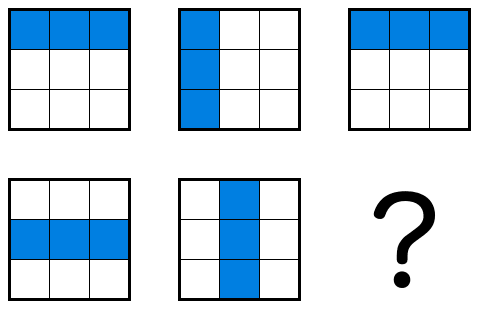
Each question is a grid with one figure missing. Pick the one that completes the pattern. No sign-up, no email. Your score appears the moment you finish.
- Questions
- 40
- Typical time
- 20–30 min
- Highest score
- 142
How it works
Solve 40 puzzles
They start easy and get harder. There is no time limit per question, but the clock runs, so work steadily. Your progress is saved in this browser if you need to stop.
Add a few details, if you like
Age, country, education and field of study are optional. They are only used to compare your score with similar people.
See where you stand
You get your IQ score, your position on the bell curve, and comparisons with each group you chose. Share the result with a link.
What the number means
IQ scores are scaled so the average is 100 and the standard deviation is 15. About half of people score between 90 and 109, and roughly 2% score above 130.
- <70
- about 2%
- 90–109
- about 50%
- 110–129
- about 23%
- 130+
- about 2%
Questions
What does this test measure?
It follows the format of Raven’s Progressive Matrices, introduced by psychologist John C. Raven in 1936. Completing visual patterns draws on abstract reasoning, working memory and pattern recognition. Because the puzzles use no words, the test works the same in any language.
How is my score calculated?
We count your correct answers and convert the count to the IQ scale. The conversion uses an estimated norm in which 22 correct answers out of 40 corresponds to 100. It is not based on a published standardization study, so treat your score as an estimate.
How long does it take?
Most people finish in 20 to 30 minutes. Aim for accuracy rather than speed.
What is the highest possible score?
142, which corresponds to answering all 40 questions correctly.
Can IQ change over time?
Scores on reasoning tests tend to peak in early adulthood and decline gradually later in life. Habits matter too: a 2025 study found that children with healthier diets scored higher, and a 2022 study linked school chess programs to higher scores.
When can I take it again?
Wait at least a year. Seeing the same puzzles again inflates the score, so your first attempt is usually the most accurate.
Is it free?
Yes. The score and all comparisons are free, and you don’t need an account or an email address.
Where are my answers stored?
Only in your browser. Unfinished progress is kept in local storage so you can resume, and your finished result is encoded in the results link itself. Nothing is sent to a server.
What are the limits of an online test?
- It measures one kind of reasoning, not every facet of intelligence.
- Conditions at home vary: fatigue and distractions affect the result.
- It is not a diagnosis and does not replace an assessment by a psychologist.
Ready when you are.
Choose the missing figure.
Keys 1–6 or A–F also work.